
The debate around augmented intelligence versus artificial intelligence gets framed the same way everywhere: one keeps humans in the loop, the other doesn't, and therefore one is safer. That framing is a philosophical position. It tells a clinic operator nothing useful.
The distinction only earns its keep when it maps to a specific workflow inside a behavioral health clinic. Not in a concept paper. On a Monday morning, with a notes queue and a denied claim and a 6pm intake call still unresolved.
This article takes the debate off the whiteboard and puts it inside a clinic. What augmented intelligence actually does in a behavioral health setting, what happens operationally when clinicians carry the full administrative load without it, and how clinic owners can deploy it without creating new problems in the process.
The question worth asking is not which type of AI is safer. The question is what a given tool does with your Tuesday afternoon.
The Debate Everyone Is Having Wrong
Why "Keeps Humans in the Loop" Tells You Nothing Operationally
Every top search result defines augmented intelligence as AI that keeps humans in the loop and stops there. That definition is accurate and almost entirely useless for a clinic operator. It names a category. It does not describe what happens inside a workflow.
The flawed assumption is that augmented intelligence is the "safe" option and autonomous AI is the "risky" one. That is a values debate. It is not an operational one. A clinic owner cannot make a staffing or technology decision based on a philosophical distinction alone.
The hidden fear driving this debate is not that AI will replace clinicians. It is that clinicians will leave because the administrative load was never addressed. Retention is the actual problem. The augmented-versus-autonomous framing rarely touches it.
The Question Clinic Owners Should Actually Be Asking
The right question is specific: what does this tool do with my 6pm intake call, my Monday notes queue, and my denied insurance claim from last Thursday?
A tool earns its place in a clinic by solving a named problem in a named workflow. Any framing that stays abstract past the first paragraph is not giving you what you need to make an operational decision.
Map the distinction onto real work. Then evaluate it.
What Augmented Intelligence Does Inside a Behavioral Health Clinic
Post-Session Notes What the Clinician Does vs. What the AI Does
A clinician finishing their fifth session of the day faces a notes queue that will take 90 minutes to clear. Augmented intelligence changes what that queue looks like, not by removing the clinician, but by removing the blank page.
The AI generates the draft. The clinician reviews, adjusts, and signs off. Clinical judgment stays with the clinician. The 90-minute task becomes a 20-minute task. That is the quantified version of what augmented intelligence reclaims. mdhub's Clinical Assistant saves clinicians up to 2 hours per day on AI clinical documentation , that figure comes from actual use, not projection.
The clinician still owns the note. The AI handles generation and formatting. That division is what augmented intelligence means in practice.
After-Hours Intake How Augmented AI Handles the 9pm Call
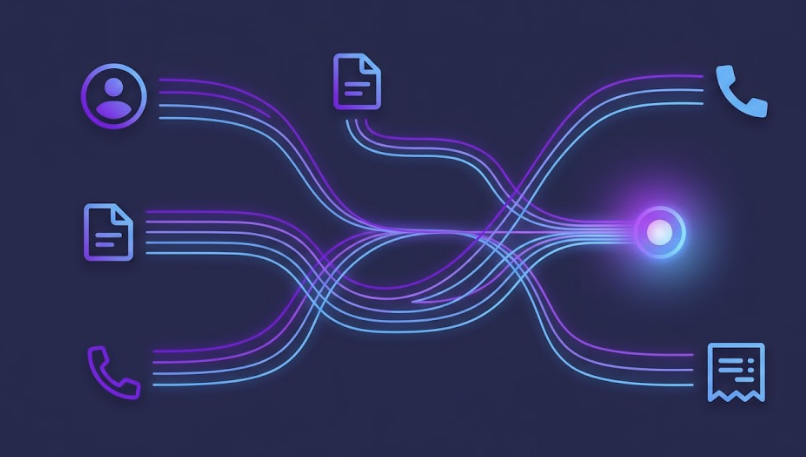
A prospective patient calls at 9pm. Without augmented support, that call goes to voicemail and sits until morning. With it, an AI intake tool screens the caller, collects presenting information, flags urgency level, and routes the case.
The clinician reviews the flagged information the next morning and makes the clinical decision. The AI handles routing. The clinician handles judgment. No intake is acted on without clinician review. That is the loop, and it is a functional one.
Denied Claims Where AI Flags and the Clinician Decides
Insurance claim validation is a documentation problem before it is a billing problem. Augmented intelligence reviews claim data against payer requirements, flags incomplete or mismatched fields before submission, and surfaces denials with the specific reason attached.
The clinician or billing staff reviews the flag and decides how to respond. The AI does not recode the claim autonomously. It identifies the problem and hands it to the person with authority to fix it. That handoff is the operational definition of augmented intelligence in a billing workflow.
What Happens to Your Clinic When Clinicians Carry the Full Administrative Load
Running a solo or small practice? Start a free trial.
The Burnout-to-Turnover Cost Sequence
Clinician turnover is not a people problem. It is a cost sequence: recruiting fees, credentialing delays, lost patient revenue during vacancy, and panel disruption that takes months to stabilize. That sequence starts with administrative load, not clinical dissatisfaction.
Clinician burnout connects directly to the gap between the job a clinician trained for and the job they actually do. When 40% of a clinician's day goes to documentation, intake triage, and follow-up, the clinical work shrinks. That gap is what drives turnover. It is addressable before the resignation happens.
Why You Cannot Scale Intake Without Solving Administrative Load First
A burned-out clinician working at reduced capacity limits how many new patients the clinic can absorb. You cannot add intake volume to a workforce that is already at its administrative ceiling. The constraint is not hiring. It is throughput on the workforce you already have.
mdhub's AI workforce platform reduces operational costs by up to 50% and increases patient intake by 30%. Those outcomes follow from solving the administrative drain first. Organizations like Talkiatry and Amen Clinics are already operating augmented intelligence at scale inside behavioral health settings, not in pilot programs, in daily clinical workflows. The compounding problem for clinic owners is real: you cannot scale what you have not first stabilized.
How Clinic Owners Deploy Augmented Intelligence Without Disrupting Care
Three Criteria to Evaluate Before Selecting a Tool
No competitor provides a decision-making framework for clinic operators considering augmented intelligence. The governance gap is real. Before selecting any tool, evaluate it against three criteria:
- EHR integration: The tool must connect to your existing system without requiring a parallel documentation workflow. If clinicians have to enter data twice, adoption fails.
- HIPAA compliance architecture: Confirm how patient data is stored, transmitted, and accessed. Augmented intelligence that handles session content must meet the same compliance standards as your current documentation. Reference ethical AI deployment principles when reviewing any vendor's compliance documentation.
- Clinician opt-in workflow: The tool should allow clinicians to review and approve AI output before it becomes part of the record. Opt-in design reduces resistance and maintains the clinical accountability structure your license requires.
How to Introduce AI to Clinicians Who Are Already Stretched
Clinician resistance usually comes from one place: the belief that a new tool will add to their workload before it reduces it. That objection is reasonable. Address it directly before asking anyone to change their workflow.
Show the 2-hour daily reclaim first. Let clinicians see what documentation automation does to their end-of-day queue before asking them to engage with intake or billing features. The adoption sequence that works is: start with documentation, demonstrate the time savings, then expand. See AI implementation guidance for intake-specific deployment steps. The clinicians who adopt early become the internal case for the clinicians who follow.
Streamline Your Practice
The friction this article addressed is specific: clinicians losing up to 2 hours daily to documentation while intake capacity stays flat and turnover risk compounds quietly in the background. mdhub's Clinical Assistant handles documentation generation and coding so clinicians spend their time reviewing and approving rather than drafting from scratch. That shift is not theoretical, it is the difference between a clinician who ends the day at capacity and one who ends it behind. If you want to see the Clinical Assistant working inside a live behavioral health workflow, book a demo at mdhub and we will show you exactly what it does.
Augmented intelligence saves time because reviewing a generated draft is faster than producing one from memory. The clinician's task shifts from drafting to approving, and that shift is where the time reclaim comes from. mdhub's Clinical Assistant saves clinicians up to 2 hours per day on documentation. That figure reflects the difference between writing a SOAP note and reading one the AI has already structured from session content. The cognitive load is lower, the output is faster, and the clinician still controls the final record.
Both organizations use augmented intelligence inside workflows where clinician review precedes every patient-facing output. The compliance protection comes from the approval layer, not from limiting what the AI processes. AI handles documentation generation and intake routing; clinicians approve before anything enters the record or reaches a patient. At scale, that structure requires clear policy on data handling, HIPAA-compliant storage architecture, and audit trails on AI-generated content. The model works because accountability stays with the clinician, and the system is built to enforce that boundary at every step.
An AI scribe captures and transcribes session content, it solves one problem inside one workflow. An augmented intelligence platform connects documentation, intake screening, and billing validation inside a single system. For a clinic with five clinicians, that distinction matters operationally: a scribe reduces note time, but it does not touch the after-hours intake call or the denied claim from last week. A platform addresses the full administrative load across all three workflows. If documentation is your only bottleneck, a scribe may be sufficient. If intake throughput and billing accuracy are also constraints, a platform gives you more leverage with the same deployment effort.